近期,我校能源动力学院硕士研究生兰清棋(一作),教师孙慧(通讯)等的研究成果“Non-invasive rotor fault measurement in pumped storage systems via enhanced energy entropy analysis and hybrid deep learning with metrological validation”在《Measurement》(IF=5.131)上发表。
论文简介如下:
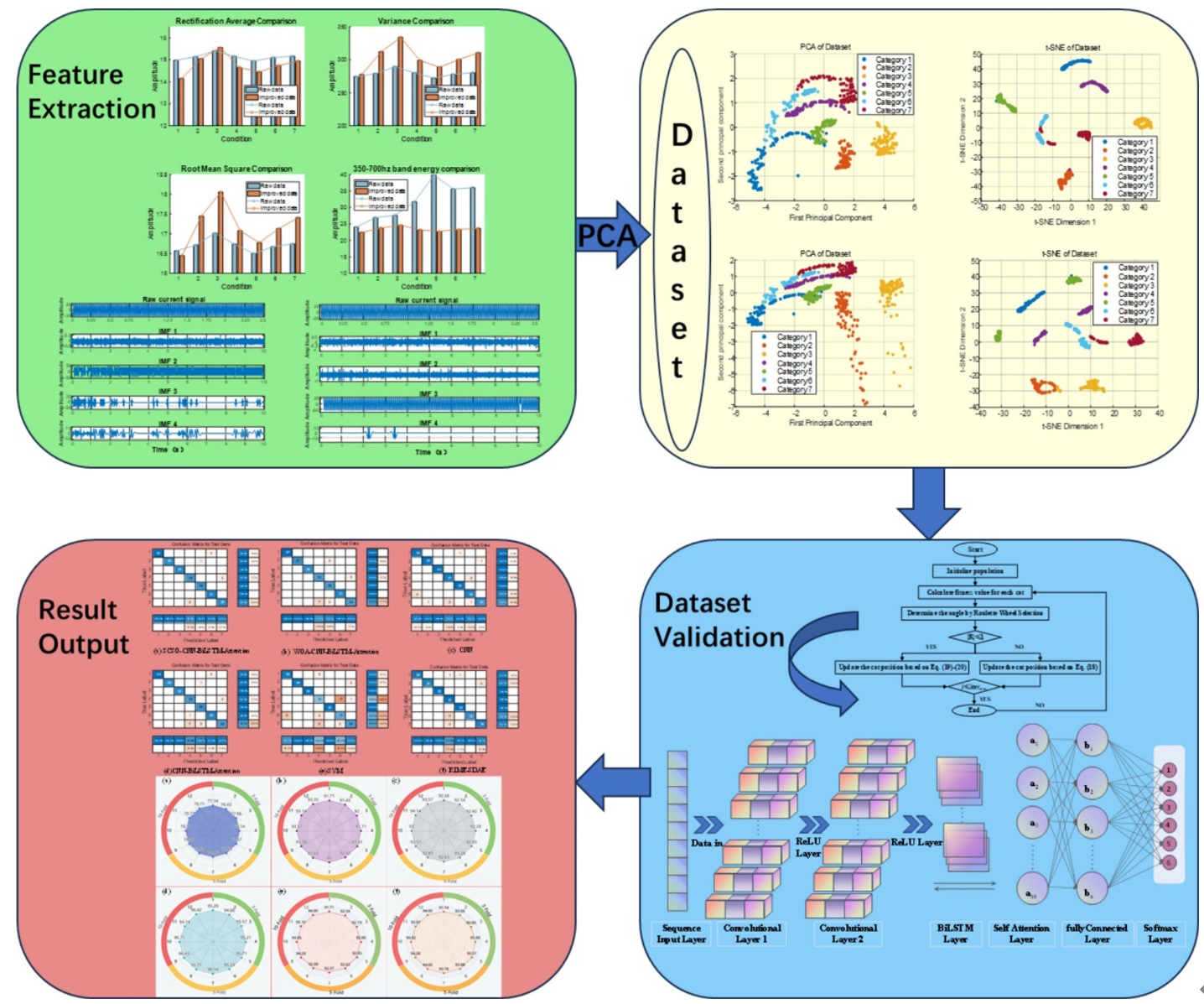
为了推进泵电系统转子健康监测的测量方法,本研究提出了一种新型非侵入式测量框架,将马达电流特征分析(MCSA)与混合深度学习相结合。该方法通过循环自相关函数(CAF)和经验模式分解(EMD)来量化能量熵变化,从而解决了信号噪声抑制和不确定性传播等关键计量学挑战。主成分分析(PCA)被严格应用,以降低特征维度,同时保持测量完整性。提出了一种新颖的SCSO-CNN-BiLSTM-注意力模型,结合了CNN的空间特征提取、BiLSTM的时间依赖建模和基于注意力的关键权重,并通过沙猫群优化(SCSO)优化,用于具有可追踪不确定度预算的超参数调优。该模型在七种故障条件下验证,测试准确率达到95.24%,在计量鲁棒性和计算效率方面均优于传统方法。关键创新包括IMF1的高频灵敏度和IMF4的低频判别能力。T-SNE可视化确认了通过整合的RMS和IMF熵特征增强了聚类。尽管空蚀耦合断层存在残留误差,该框架仍展现出稳健的泛化性和实时潜能。这项工作为离心泵健康监测提供了基于物理的人工智能解决方案,平衡诊断精度与计算效率,应用于工业部署。
To advance measurement methodologies for rotor health monitoring in pumped storage systems, this study proposes a novel non-invasive measurement framework integrating Motor Current Signature Analysis (MCSA) with hybrid deep learning. This method quantifies energy entropy shifts by employing Cyclic Autocorrelation Function (CAF) and Empirical Mode Decomposition (EMD), thereby addressing key metrological challenges including signal noise suppression and uncertainty propagation. Principal Component Analysis (PCA) is rigorously applied to reduce feature dimensionality while preserving measurement integrity. A novel SCSO-CNN-BiLSTM-Attention model is proposed, combining CNN’s spatial feature extraction, BiLSTM’s temporal dependency modeling, and attention-based critical weighting, optimized via Sand Cat Swarm Optimization (SCSO) for hyperparameter tuning with traceable uncertainty budgets. Validated on seven fault conditions, the model achieves 95.24% testing accuracy, outperforming traditional methods in both metrological robustness and computational efficiency. Key innovations include IMF1’s high-frequency sensitivity and IMF4’s low-frequency discriminability. T-SNE visualization confirms enhanced clustering through integrated RMS and IMF entropy features. Despite residual errors in cavitation-coupled faults, the framework demonstrates robust generalizability and real-time potential. This work provides a physics-informed AI solution for centrifugal pump health monitoring, balancing diagnostic precision with computational efficiency for industrial deployment.